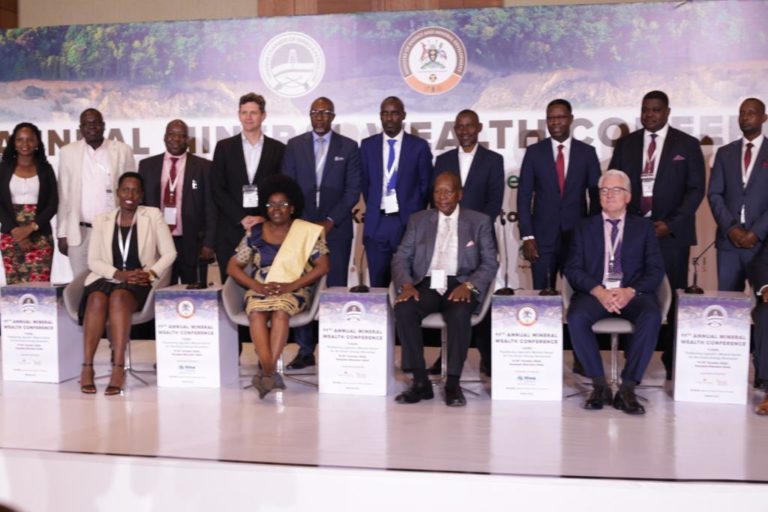

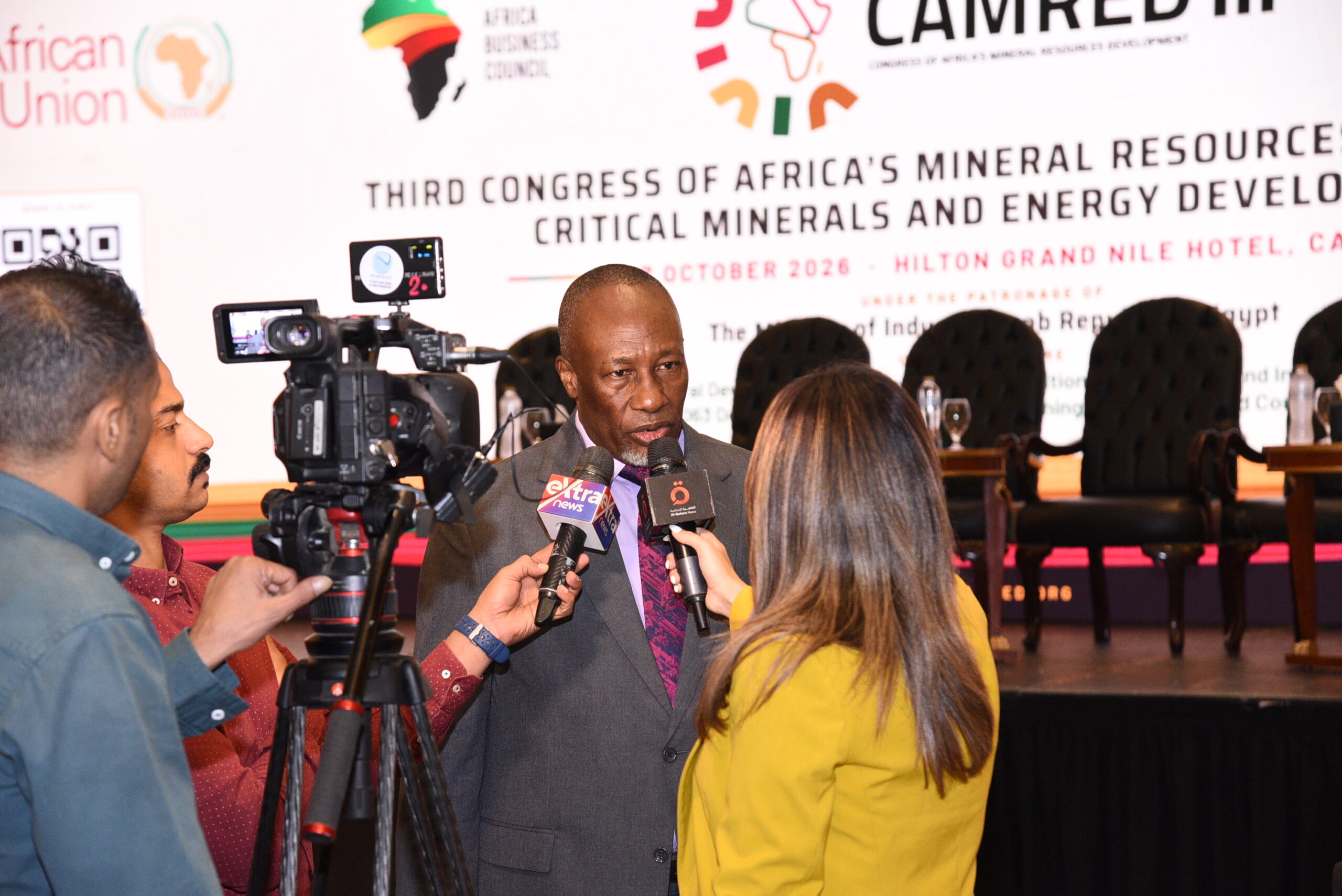
Dr Frank Dixon Mugyenyi, Founder and Global Executive Director of the Minerals Africa Development Institution (MADI), calls for manufacturing to take centre stage in Africa’s mineral development strategy.
Africa’s mineral wealth presents an enormous opportunity for economic transformation. Yet, despite holding a significant share of the world’s mineral reserves, the continent continues to export many of its resources in raw or minimally processed form, leaving much of the industrial value, jobs and revenue to be generated elsewhere.
This was the central message delivered by Dr Frank Dixon Mugyenyi during the opening of the Third Congress of Africa’s Mineral Resources Development (CAMRED III), held in Cairo, Egypt, from 5 to 7 October 2026.
Convened under the theme “Africa’s Wealth for Africa,” the congress brought together government leaders, mining companies, investors, financial institutions and development partners to advance discussions on mineral development, local content, value addition and industrialisation. The event was organised by the Africa Business Council through its Minerals Resources Development Cluster, in partnership with MADI and other continental and international partners.
Beyond Extraction: Where Africa’s Mineral Wealth Goes
In his opening reflections, Dr Mugyenyi challenged delegates to reconsider Africa’s place in the global economy, beginning with the continent’s size and resource endowment.
Africa covers approximately 30.37 million square kilometres and is home to vast deposits of minerals essential to modern industry, including cobalt, copper, manganese, graphite, chromium, bauxite and platinum group metals.
Yet, as Dr Mugyenyi observed, the continent’s economic output remains disproportionately small compared with the scale of its resources and population.
The challenge, he argued, is not simply a lack of resources. It is the limited capacity to transform those resources into higher-value products through processing, manufacturing and industrial production.
While African minerals supply industries across the world, many of the products made from them, including batteries, vehicles, electrical equipment and machinery, are manufactured outside the continent.
For Dr Mugyenyi, this is where Africa’s development challenge lies: not only in what it extracts, but in what it manufactures.
Why Value Addition Must Go Hand in Hand with Manufacturing
Africa has long recognised the importance of mineral beneficiation and value addition. The Africa Mining Vision, adopted by African Heads of State and Government in 2009, provides a continental framework for using mineral resources to support broader economic and industrial development. However, Dr Mugyenyi noted that processing minerals alone will not deliver the desired transformation without industries capable of using the resulting products.
A refinery needs customers. Processed copper requires wire and cable manufacturers. Refined battery materials need battery production facilities. Iron ore processing must connect to steelmaking, fabrication and engineering industries.
Without these downstream industries, Africa risks exporting processed materials while continuing to import finished products. His message was clear: value addition must be driven by manufacturing demand, not processing requirements alone.
Building the Foundations for African Industrialisation
Dr Mugyenyi called for manufacturing to become central to Africa’s mineral development strategy, supported by practical investments and coordinated policies.
Key priorities include:
Mineral industrial parks: Establishing industrial facilities near mines, energy sources and transport corridors, linking mineral processing with downstream manufacturing.
Regional manufacturing hubs: Developing cross-border value chains in sectors such as batteries, electric mobility, copper products, steel and engineering.
Mineral-focused special economic zones: Creating competitive industrial environments with reliable infrastructure, efficient customs processes and stronger local supplier participation.
Continental market integration: Leveraging the African Continental Free Trade Area (AfCFTA) to expand markets for products manufactured from African minerals.
Infrastructure, skills and finance: Improving access to affordable energy, transport, technical education, technology partnerships and long-term investment.
Policy alignment: Coordinating mining, industrial and investment policies to support the Africa Mining Vision, Agenda 2063 and the African Union’s green minerals agenda.
These priorities reflect CAMRED III’s broader ambition to connect policy discussions with investment opportunities, partnerships and implementable projects. The congress programme also included high-level dialogues on critical minerals, local content, technology, financing and regional integration.
From Continental Dialogue to Action
CAMRED III provided a platform for African governments, businesses and development partners to consider how the continent can retain more value from its mineral resources.
For MADI, the priority is to advance a model of mineral development that supports industrialisation, strengthens African enterprises and creates wider economic opportunities.
Dr Mugyenyi emphasised that Africa cannot close the economic gap by exporting more raw materials or relying on mineral processing alone. The continent must also build the industries that use those materials to produce goods, create jobs and support competitive economies.
As CAMRED continues to bring together stakeholders across the mineral value chain, the task ahead is to turn these priorities into bankable projects, regional partnerships and sustainable industrial capacity.
Africa’s wealth is not measured only by what lies beneath its soil, but by what its people can build from it. The next phase of mineral development must ensure that Africa’s resources become the foundation for African industry, jobs and shared prosperity.